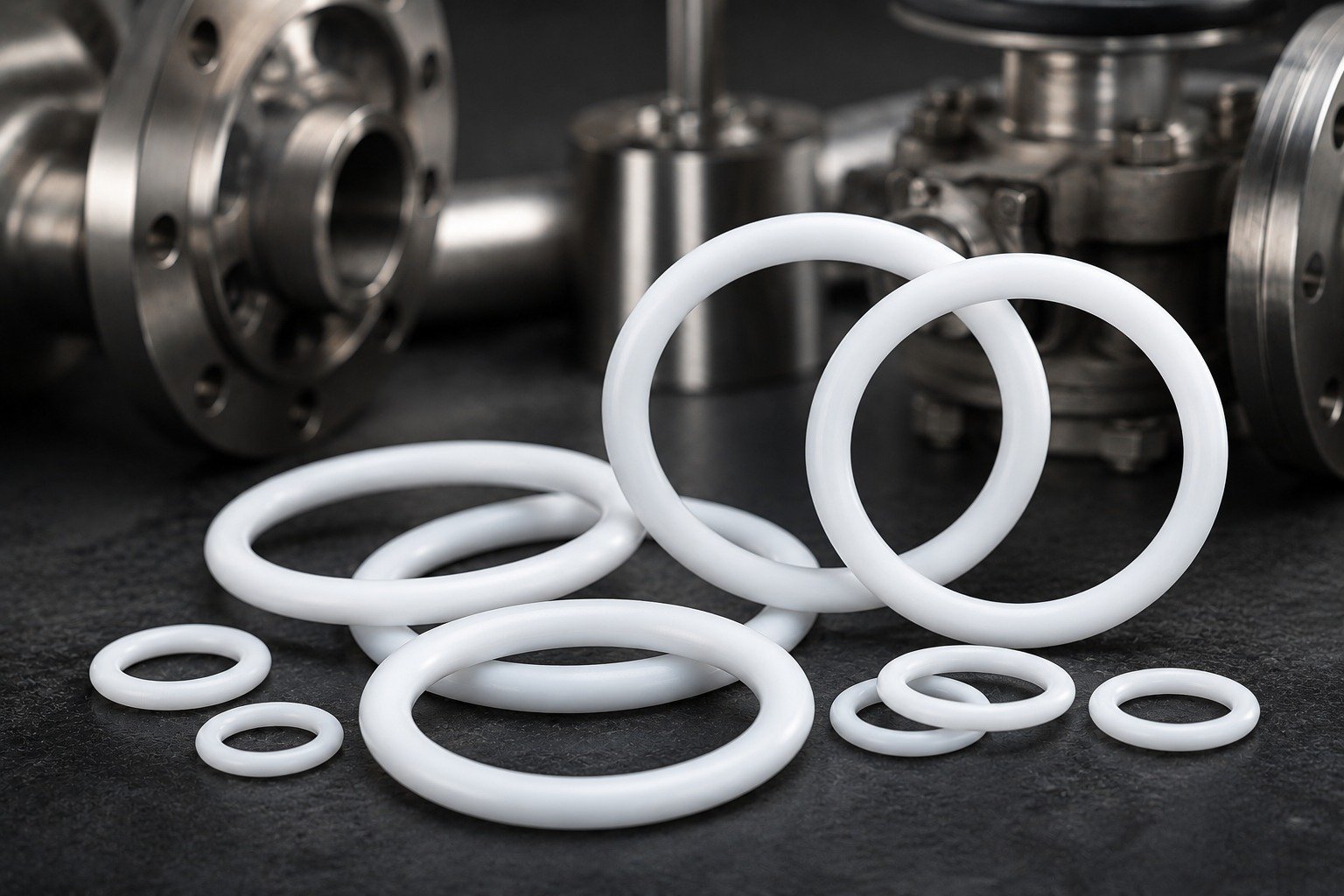
In the oil and gas industry, a seal failure isn’t just a maintenance headache — it can mean unplanned downtime, safety risks, and costly product loss. That’s why choosing the right PTFE grade for O-rings and seals is one of the most critical material decisions an engineer or procurement team can make.
PTFE (Polytetrafluoroethylene) is prized in this sector for its exceptional chemical resistance, wide temperature range, and low friction. Even so, not every PTFE is made equally. The base resin can be modified with fillers, and each formulation performs differently under pressure, temperature, and chemical exposure. Here’s what to consider.
1. Virgin PTFE: The Baseline
Virgin (unfilled) PTFE offers the purest chemical resistance and is ideal for applications involving highly corrosive fluids or where product purity matters. However, it has lower mechanical strength and is more prone to cold flow (deformation under sustained pressure), making it less suited to high-load static seals.
2. Glass-Filled PTFE
Adding glass fiber (typically 15-25%) significantly improves wear resistance, creep resistance, and dimensional stability under load. Although it may be somewhat more abrasive to mating surfaces and less chemically inert than virgin PTFE, this grade is a good option for rotary seals and applications involving abrasive media.
3. Carbon-Filled PTFE
Carbon fillers enhance thermal conductivity, compressive strength, and wear resistance while maintaining good chemical resistance — making this grade well-suited for high-pressure valve seals and applications with elevated operating temperatures common in downstream processing.
4. Bronze-Filled PTFE
Bronze filler improves thermal conductivity and wear resistance further, but it reduces chemical resistance — bronze-filled PTFE is vulnerable to acidic or highly corrosive environments. It’s a good fit for hydraulic and pneumatic systems where chemical exposure is minimal but heat dissipation matters.
5. Matching Grade to Application
The right choice comes down to 3 questions:
What’s the chemical exposure? Sour gas, acids, and solvents call for virgin or carbon-filled PTFE.
What’s the pressure and load profile? High-load static seals benefit from glass or carbon fillers to resist creep.
What’s the operating temperature? Higher temperatures favor carbon or bronze fillers for better thermal stability.
Why This Matters for Oil & Gas Operators
In upstream and downstream applications alike, seal failure can compromise safety and shut down operations. Selecting the correct PTFE grade upfront — rather than defaulting to a generic option — reduces the risk of premature wear, leakage, and unplanned replacements, ultimately protecting both equipment and personnel.
At Hi-Tech Polymers, our engineering team works with clients to identify the right PTFE compound for their specific operating conditions, ensuring seals perform reliably even in the industry’s harshest environments.
Have a specific application in mind? Get in touch with our team to discuss the ideal PTFE grade for your seals.